> ## Documentation Index
> Fetch the complete documentation index at: https://docs.cnmcp.com/llms.txt
> Use this file to discover all available pages before exploring further.
# Overview
> Introduction to the Model Context Protocol (MCP) Java SDK
Java SDK for the [Model Context Protocol](https://modelcontextprotocol.org/docs/concepts/architecture)
enables standardized integration between AI models and tools.
## Features
* MCP Client and MCP Server implementations supporting:
* Protocol [version compatibility negotiation](https://spec.modelcontextprotocol.io/specification/2024-11-05/basic/lifecycle/#initialization)
* [Tool](https://spec.modelcontextprotocol.io/specification/2024-11-05/server/tools/) discovery, execution, list change notifications
* [Resource](https://spec.modelcontextprotocol.io/specification/2024-11-05/server/resources/) management with URI templates
* [Roots](https://spec.modelcontextprotocol.io/specification/2024-11-05/client/roots/) list management and notifications
* [Prompt](https://spec.modelcontextprotocol.io/specification/2024-11-05/server/prompts/) handling and management
* [Sampling](https://spec.modelcontextprotocol.io/specification/2024-11-05/client/sampling/) support for AI model interactions
* Multiple transport implementations:
* Default transports:
* Stdio-based transport for process-based communication
* Java HttpClient-based SSE client transport for HTTP SSE Client-side streaming
* Servlet-based SSE server transport for HTTP SSE Server streaming
* Spring-based transports:
* WebFlux SSE client and server transports for reactive HTTP streaming
* WebMVC SSE transport for servlet-based HTTP streaming
* Supports Synchronous and Asynchronous programming paradigms
## Architecture
The SDK follows a layered architecture with clear separation of concerns:
 * **Client/Server Layer (McpClient/McpServer)**: Both use McpSession for sync/async operations,
with McpClient handling client-side protocol operations and McpServer managing server-side protocol operations.
* **Session Layer (McpSession)**: Manages communication patterns and state using DefaultMcpSession implementation.
* **Transport Layer (McpTransport)**: Handles JSON-RPC message serialization/deserialization via:
* StdioTransport (stdin/stdout) in the core module
* HTTP SSE transports in dedicated transport modules (Java HttpClient, Spring WebFlux, Spring WebMVC)
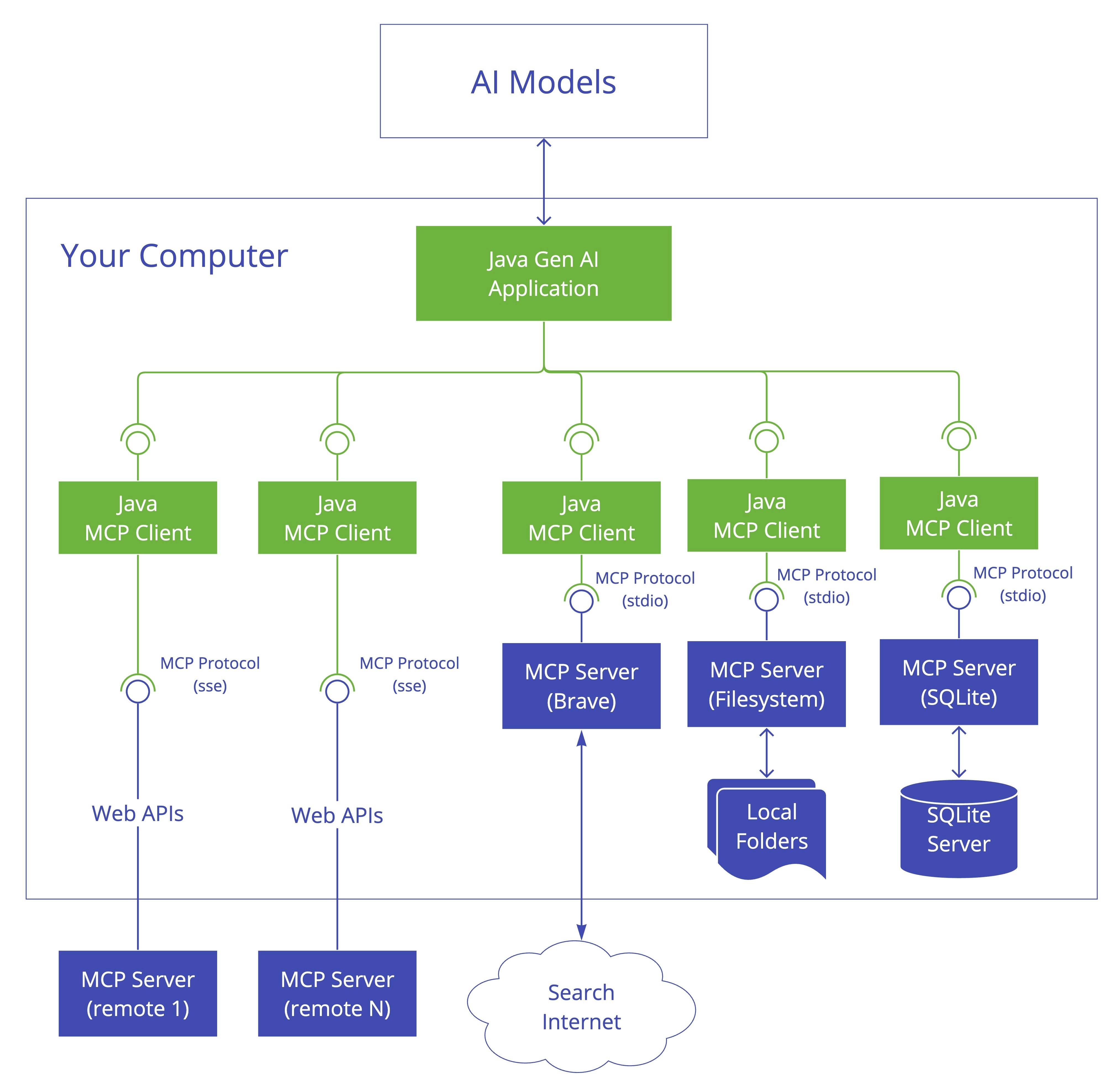
The MCP Client is a key component in the Model Context Protocol (MCP) architecture, responsible for establishing and managing connections with MCP servers.
It implements the client-side of the protocol.
* **Client/Server Layer (McpClient/McpServer)**: Both use McpSession for sync/async operations,
with McpClient handling client-side protocol operations and McpServer managing server-side protocol operations.
* **Session Layer (McpSession)**: Manages communication patterns and state using DefaultMcpSession implementation.
* **Transport Layer (McpTransport)**: Handles JSON-RPC message serialization/deserialization via:
* StdioTransport (stdin/stdout) in the core module
* HTTP SSE transports in dedicated transport modules (Java HttpClient, Spring WebFlux, Spring WebMVC)
The MCP Client is a key component in the Model Context Protocol (MCP) architecture, responsible for establishing and managing connections with MCP servers.
It implements the client-side of the protocol.
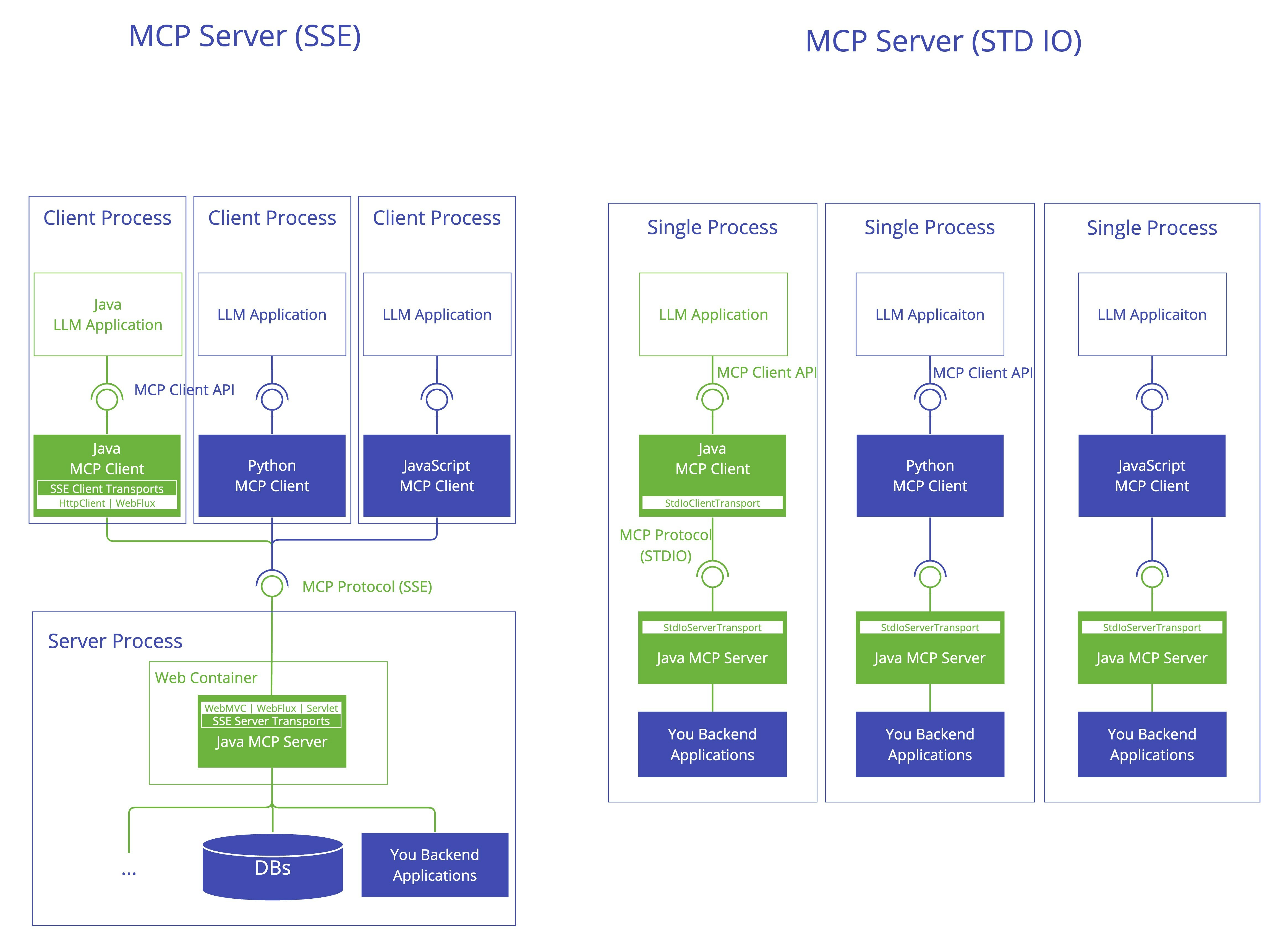
 The MCP Server is a foundational component in the Model Context Protocol (MCP) architecture that provides tools, resources, and capabilities to clients.
It implements the server-side of the protocol.
The MCP Server is a foundational component in the Model Context Protocol (MCP) architecture that provides tools, resources, and capabilities to clients.
It implements the server-side of the protocol.
 Key Interactions:
* **Client/Server Initialization**: Transport setup, protocol compatibility check, capability negotiation, and implementation details exchange.
* **Message Flow**: JSON-RPC message handling with validation, type-safe response processing, and error handling.
* **Resource Management**: Resource discovery, URI template-based access, subscription system, and content retrieval.
## Dependencies
Add the following Maven dependency to your project:
The core MCP functionality:
```xml theme={null}
io.modelcontextprotocol.sdk
mcp
```
For HTTP SSE transport implementations, add one of the following dependencies:
```xml theme={null}
io.modelcontextprotocol.sdk
mcp-spring-webflux
io.modelcontextprotocol.sdk
mcp-spring-webmvc
```
The core MCP functionality:
```groovy theme={null}
dependencies {
implementation platform("io.modelcontextprotocol.sdk:mcp")
//...
}
```
For HTTP SSE transport implementations, add one of the following dependencies:
```groovy theme={null}
// Spring WebFlux-based SSE client and server transport
dependencies {
implementation platform("io.modelcontextprotocol.sdk:mcp-spring-webflux")
}
// Spring WebMVC-based SSE server transport
dependencies {
implementation platform("io.modelcontextprotocol.sdk:mcp-spring-webmvc")
}
```
### Bill of Materials (BOM)
The Bill of Materials (BOM) declares the recommended versions of all the dependencies used by a given release.
Using the BOM from your application's build script avoids the need for you to specify and maintain the dependency versions yourself.
Instead, the version of the BOM you're using determines the utilized dependency versions.
It also ensures that you're using supported and tested versions of the dependencies by default, unless you choose to override them.
Add the BOM to your project:
```xml theme={null}
io.modelcontextprotocol.sdk
mcp-bom
0.7.0
pom
import
```
```groovy theme={null}
dependencies {
implementation platform("io.modelcontextprotocol.sdk:mcp-bom:0.7.0")
//...
}
```
Gradle users can also use the Spring AI MCP BOM by leveraging Gradle (5.0+) native support for declaring dependency constraints using a Maven BOM.
This is implemented by adding a 'platform' dependency handler method to the dependencies section of your Gradle build script.
As shown in the snippet above this can then be followed by version-less declarations of the Starter Dependencies for the one or more spring-ai modules you wish to use, e.g. spring-ai-openai.
Replace the version number with the version of the BOM you want to use.
### Available Dependencies
The following dependencies are available and managed by the BOM:
* Core Dependencies
* `io.modelcontextprotocol.sdk:mcp` - Core MCP library providing the base functionality and APIs for Model Context Protocol implementation.
* Transport Dependencies
* `io.modelcontextprotocol.sdk:mcp-spring-webflux` - WebFlux-based Server-Sent Events (SSE) transport implementation for reactive applications.
* `io.modelcontextprotocol.sdk:mcp-spring-webmvc` - WebMVC-based Server-Sent Events (SSE) transport implementation for servlet-based applications.
* Testing Dependencies
* `io.modelcontextprotocol.sdk:mcp-test` - Testing utilities and support for MCP-based applications.
Key Interactions:
* **Client/Server Initialization**: Transport setup, protocol compatibility check, capability negotiation, and implementation details exchange.
* **Message Flow**: JSON-RPC message handling with validation, type-safe response processing, and error handling.
* **Resource Management**: Resource discovery, URI template-based access, subscription system, and content retrieval.
## Dependencies
Add the following Maven dependency to your project:
The core MCP functionality:
```xml theme={null}
io.modelcontextprotocol.sdk
mcp
```
For HTTP SSE transport implementations, add one of the following dependencies:
```xml theme={null}
io.modelcontextprotocol.sdk
mcp-spring-webflux
io.modelcontextprotocol.sdk
mcp-spring-webmvc
```
The core MCP functionality:
```groovy theme={null}
dependencies {
implementation platform("io.modelcontextprotocol.sdk:mcp")
//...
}
```
For HTTP SSE transport implementations, add one of the following dependencies:
```groovy theme={null}
// Spring WebFlux-based SSE client and server transport
dependencies {
implementation platform("io.modelcontextprotocol.sdk:mcp-spring-webflux")
}
// Spring WebMVC-based SSE server transport
dependencies {
implementation platform("io.modelcontextprotocol.sdk:mcp-spring-webmvc")
}
```
### Bill of Materials (BOM)
The Bill of Materials (BOM) declares the recommended versions of all the dependencies used by a given release.
Using the BOM from your application's build script avoids the need for you to specify and maintain the dependency versions yourself.
Instead, the version of the BOM you're using determines the utilized dependency versions.
It also ensures that you're using supported and tested versions of the dependencies by default, unless you choose to override them.
Add the BOM to your project:
```xml theme={null}
io.modelcontextprotocol.sdk
mcp-bom
0.7.0
pom
import
```
```groovy theme={null}
dependencies {
implementation platform("io.modelcontextprotocol.sdk:mcp-bom:0.7.0")
//...
}
```
Gradle users can also use the Spring AI MCP BOM by leveraging Gradle (5.0+) native support for declaring dependency constraints using a Maven BOM.
This is implemented by adding a 'platform' dependency handler method to the dependencies section of your Gradle build script.
As shown in the snippet above this can then be followed by version-less declarations of the Starter Dependencies for the one or more spring-ai modules you wish to use, e.g. spring-ai-openai.
Replace the version number with the version of the BOM you want to use.
### Available Dependencies
The following dependencies are available and managed by the BOM:
* Core Dependencies
* `io.modelcontextprotocol.sdk:mcp` - Core MCP library providing the base functionality and APIs for Model Context Protocol implementation.
* Transport Dependencies
* `io.modelcontextprotocol.sdk:mcp-spring-webflux` - WebFlux-based Server-Sent Events (SSE) transport implementation for reactive applications.
* `io.modelcontextprotocol.sdk:mcp-spring-webmvc` - WebMVC-based Server-Sent Events (SSE) transport implementation for servlet-based applications.
* Testing Dependencies
* `io.modelcontextprotocol.sdk:mcp-test` - Testing utilities and support for MCP-based applications.